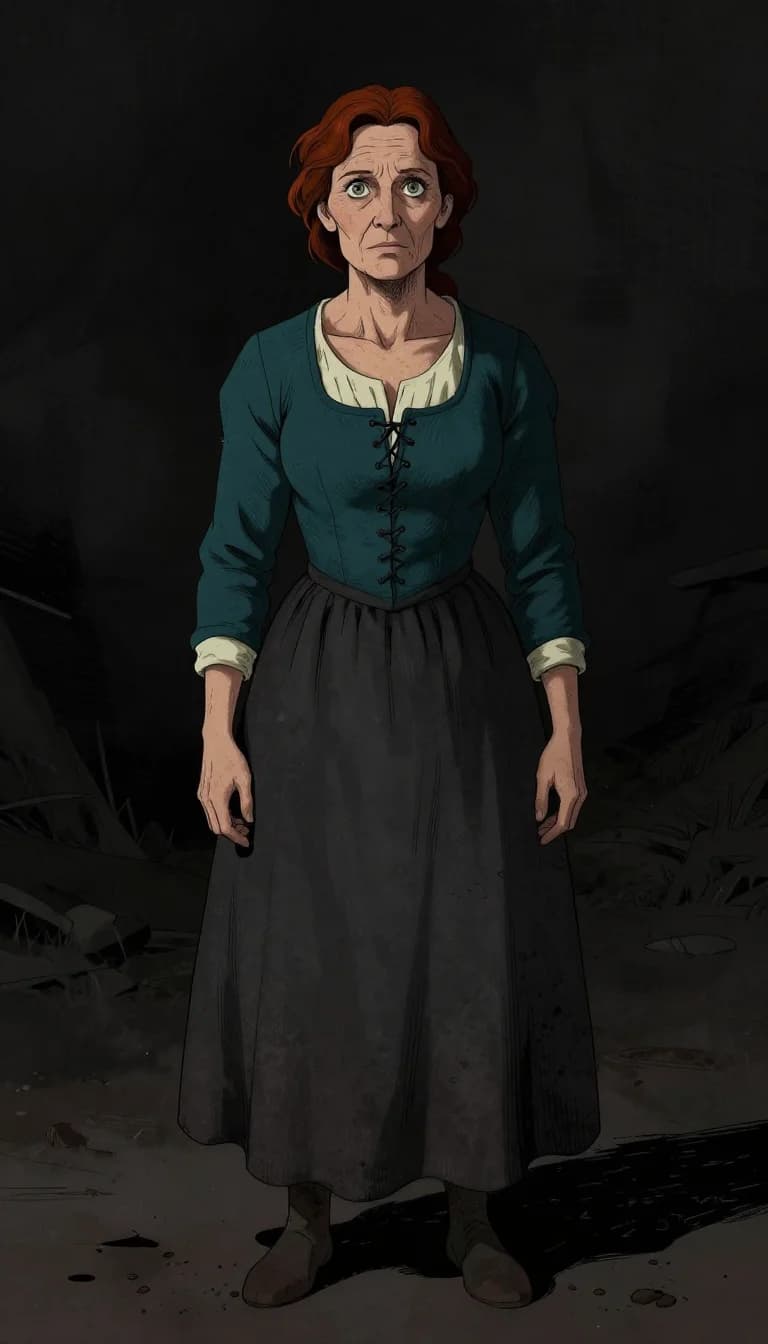
Maren Hale

Chapter 4

The Mercy of Unwritten Things

Brought under supervision into the concealed settlement, Maren witnesses a community formed from compromise, mingling, and deliberate reinvention: English remnants, Algonquian knowledge, and hard-learned customs of silence bound into a fragile civic life. Asha guides her through workshops, storehouses, and prayer spaces, not to welcome her fully, but to force her to understand what disclosure would actually destroy. Maren's instinct to authenticate everything drives her to search for proof of her father's presence, and she finds it in a preserved ledger fragment and a chart overlay written in Edmund Hale's own hand. Yet the evidence does not vindicate her quest. Instead it reveals that Edmund knew the settlement lived, understood the Crown's appetite for claiming and consuming such knowledge, and chose concealment as an act of protection. Maren's inheritance turns inside out: she did not receive an unfinished duty to publish the truth, but a deferred judgment about whether she deserves to carry it. The chapter ends as she burns the page of notes she made on landing, choosing, for the first time, not merely to know the community's danger, but to participate in guarding it.

Part 2: The People Who Chose to Vanish3 scenes927 words

Chapter Summary

Brought under supervision into the concealed settlement, Maren witnesses a community formed from compromise, mingling, and deliberate reinvention: English remnants, Algonquian knowledge, and hard-learned customs of silence bound into a fragile civic life. Asha guides her through workshops, storehouses, and prayer spaces, not to welcome her fully, but to force her to understand what disclosure would actually destroy. Maren's instinct to authenticate everything drives her to search for proof of her father's presence, and she finds it in a preserved ledger fragment and a chart overlay written in Edmund Hale's own hand. Yet the evidence does not vindicate her quest. Instead it reveals that Edmund knew the settlement lived, understood the Crown's appetite for claiming and consuming such knowledge, and chose concealment as an act of protection. Maren's inheritance turns inside out: she did not receive an unfinished duty to publish the truth, but a deferred judgment about whether she deserves to carry it. The chapter ends as she burns the page of notes she made on landing, choosing, for the first time, not merely to know the community's danger, but to participate in guarding it.

Scene 1

320 words

Asha brings Maren into the concealed settlement under watch, moving her through lanes and workrooms arranged to confuse pursuit rather than impress a visitor. Maren sees English tools remade by Algonquian methods, storehouses planned around seasons rather than trade, and prayer spaces where old rites have softened into shared discipline. The community's ordinary life unsettles her more deeply than ruins would have done, because every visible detail proves that disclosure would endanger living people rather than solve a historical absence.

The path narrowed until cedar brushed Maren's sleeves and left resin on the wool. Asha walked half a pace ahead, silent as a warning, while two others followed behind with their hands empty and watchful. When the screen of branches opened, there was no ruin, no noble desolation waiting to be measured. There were lanes, bent deliberately out of sight of one another, smoke lifting through damp thatch, and the low sound of work continuing because it had learned not to pause for fear.

Children knelt over a stone bowl, grinding corn with steady arms. Beside them, an English hinge, black with age, had been beaten into a clasp for a woven grain chest. Nets hung from peeled poles near scraped parchment pages drying in the weak light, their old ink ghosting beneath new marks Maren could not read. In a workroom roofed with bark and salvaged board, a woman fitted a knife blade into a handle shaped by a method no London cutler would have known, though the iron bore a London maker's stamp.

Maren's fingers went to the notebook hidden under her bodice before thought could govern them. Asha turned and pressed two fingers to her wrist. The touch was not cruel. It was worse than cruelty: exact, lawful, already agreed upon by every face that had lifted to judge her and then returned to its task.

They passed a meeting room where old church lettering ran along a beam turned inward, half-shadowed by carved signs and hanging herbs. No prayer here seemed untouched, yet nothing felt abandoned. Maren tried to set the lanes in order in her mind and failed. They doubled back, broke, hid courtyards inside courtyards. This was not disorder. It was a map made to defeat maps.

By the storehouse, with cornmeal dust pale on dark hands and English iron, Maren understood that a line drawn truly could still become a road for harm.

Scene 2

302 words

Driven by grief and professional instinct, Maren searches for proof that her father truly reached the settlement. In a guarded store of preserved fragments, she finds a ledger scrap and a chart overlay bearing Edmund Hale's unmistakable hand. The discovery first feels like vindication, then turns against her: Edmund recorded enough to prove the colony lived, but his marginal instructions warn that any complete chart would become an instrument of possession.

Asha let her pass only after the elder's key had worried the latch loose and a second woman took her place before the shelves. Maren felt the door close at her back like a verdict. The room smelled of cedar smoke, damp earth, and old oil rubbed into cloth until the fibers shone. Nothing here had the vanity of an archive. Bundles lay low in reed trays; knots of tally cord hung beside winter seed marks; scraps of paper slept beneath stones as if a breath might scatter them.

She told herself she sought sequence, provenance, proof. Her fingers betrayed her, moving too quickly from bundle to bundle, lifting each oiled wrapping with a care sharpened by hunger. The cloth clung faintly to her skin. Asha watched without speaking.

Then the coast appeared.

It was no larger than her hand, an overlay cut thin, meant to rest beneath another chart and alter it by stealth. The ink had browned at the feathered edges, but the pressure was Edmund Hale's: exact, restrained, mercilessly clear. A river mouth corrected in the margin. A shoal pricked twice, the second mark smaller. Beside it, a torn ledger scrap named stores, households, and three winter deaths in the narrow script Maren had copied as a child until her wrist ached.

For one breath, triumph rose so hard it hurt. He had been here. He had seen. Her life had not been built on a ghost.

Then she read the line beneath the tally.

To chart them plainly is to deliver them.

The words stripped the room of air. Edmund had not failed to finish the map. He had stopped his own hand. Maren stared until the brown ink blurred, while Asha's silence asked what Maren would make of the proof now that it had become a warning.

Scene 3

305 words

Alone with the notes she made upon landing, Maren confronts the harm contained in even partial observation. She burns the page, giving up the first proof she personally gathered and accepting that restraint must become action rather than sentiment. Asha witnesses the choice and offers neither praise nor absolution, only a harder invitation: Edmund left one final thing behind, and by morning Maren must decide whether she seeks it as a cartographer or as a guardian.

Night had thinned the settlement to its smallest sounds: the rasp of insects beyond the trees, the soft shift of a watcher's foot, the fire breathing low in its ring of stones. Maren sat apart from the sleeping houses with her first page unfolded on her knees. The ink had dried brown in the damp air. Shoreline angle. Creek mouth by split pine. Smoke seen west of landing. Three spare phrases, no more damning in London than a pin set into wax.

Here, they were a summons.

She saw, with a clarity that made her hands cold, the page carried across water, copied under candlelight by men who had never smelled the corn stores or heard a child stifle laughter behind a woven door. They would not read caution in her neatness. They would read approach. They would turn Asha's hidden paths into lines of entry, her father's mercy into a defect corrected by braver daughters.

Maren lifted the parchment before she could make a virtue of hesitating. The corner touched flame. It blackened, tightened, then bloomed into a trembling orange lace. Her measurements shrank first, then the creek mark, then the words she had trusted because they were hers. Smoke bit her throat. She kept watching until the last ruled line lost itself among the coals.

The loss was absurdly small. One page. One night's work. Yet something in her, trained for years to preserve every margin, answered it like an amputation.

Asha came forward only after the ash folded inward. Firelight struck one side of her face and left the other unreadable.

"Edmund left one thing more," she said. "Kept for the one who could bear what he would not publish. Ask for it by morning if you must. But know whether you come for a map, Maren Hale, or for a trust."

The Mercy of Unwritten Things | Maren Hale | Fictures